125kHz T5577 Rewritable Card Pack
Product documentation menu
Blank rewritable 125kHz cards for writing a captured Prox, EM, AWID or Indala credential onto something you can hand to a reader.
Blank T5577 cards: what a captured 125kHz credential is written to, as many times as you need.
| Frequency | 125kHz |
| Chip | T5577, rewritable |
| Carries | Prox, EM4100 / Net2, AWID, Indala, Avigilon, IO Prox, Pyramid, Paradox and Securakey card data |
| Written with | A Proxmark or an ATLAS Chameleon Ultra |
A long range reader in a bag gives you a facility code and a card number. That is not yet a way through the door. Some doors want a card in a hand: the guard at the desk takes the badge and looks at it, the turnstile swallows a visitor card and gives it back on the way out, a teammate needs a working credential of their own.
A T5577 is the plastic for that. It is a blank, rewritable 125kHz card, and once the captured data is written to it the reader and the controller see no difference between it and the original.
Two ways to write it in ATLAS
| Proxmark | ATLAS Chameleon Ultra | |
|---|---|---|
| Where in ATLAS | Cards, the CORP tab, WRITE / SIM | Cards, the ULTRA tab, the WRITE chip |
| Pick it when | A Proxmark is what you carry | The Chameleon Ultra is what is in your pocket. There is no Proxmark in the chain and nothing else to plug in |
| The blank | A T5577 on the Proxmark antenna | A T5577 laid flat on the Chameleon Ultra |
| How the write runs | Up to five attempts by default, stopping early when the tag confirms the write, with Move Card Slowly between them | One write, then one read back. Hold the card still until the message arrives |
| What a good write reads | Card Written, with a line under it saying how the write was confirmed | Card written and verified |
Both forms carry Import from Database above the card data. It opens the cards already in your projects and fills the whole form from the one you pick. Going the other way, a long press on a record in the Card Database offers Open in Card Writer, which always switches to Cards, opens CORP and fills the Proxmark writer. It does not fill the Chameleon Ultra’s WRITE form, which fills only through its own Import from Database.
Pick the reading before you write it
A Wiegand frame does not say which format it is. Several formats share a bit length, and each one cuts the same bits into a different facility code and card number. ATLAS lists every format a captured card is a valid card of on one dropdown, with the reader’s own reading marked (Reader Suggested), and Open in Card Writer loads the one you picked.
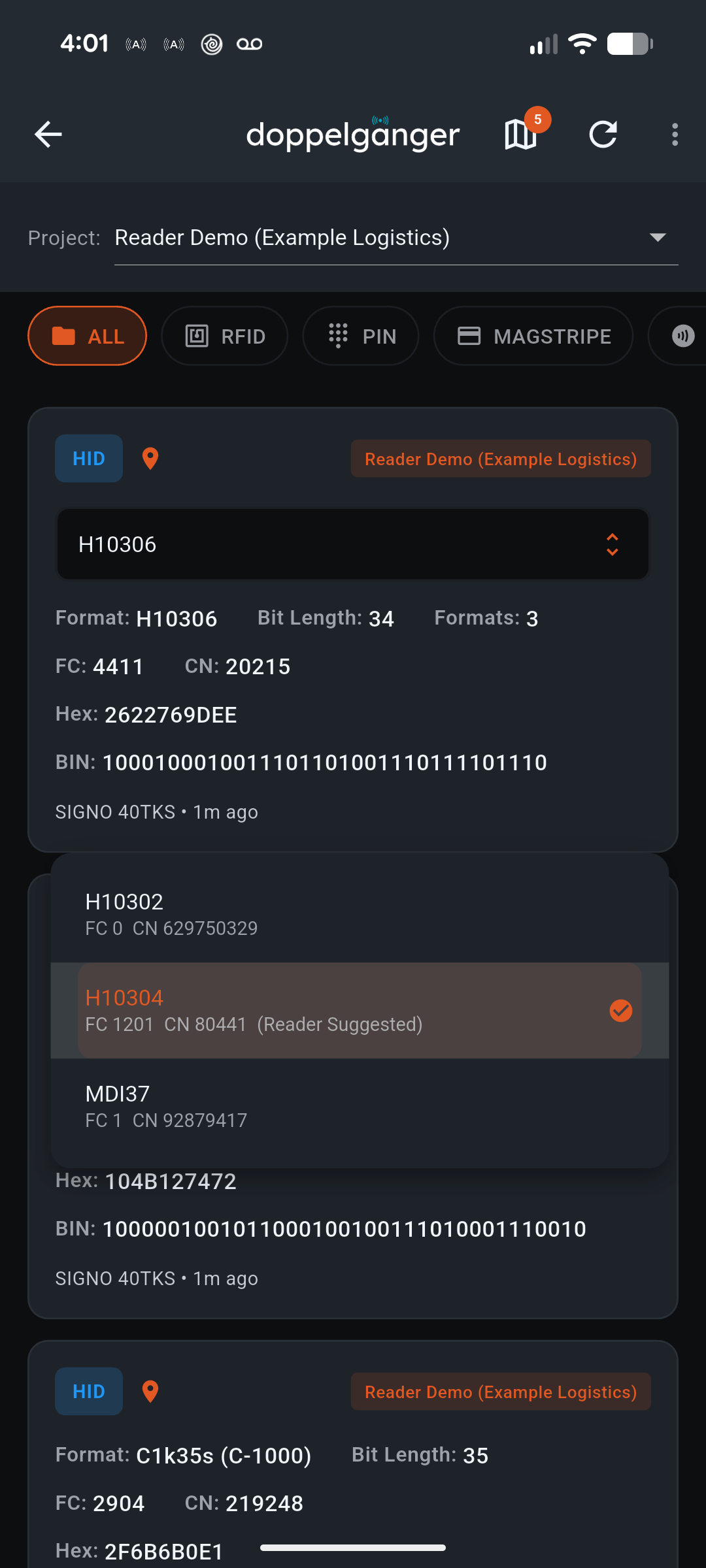
- H10302, the same bits read as one long card number.
- H10304, marked (Reader Suggested), which is what the reader reported.
- MDI37, a third valid reading.
Writing a T5577 with a Proxmark
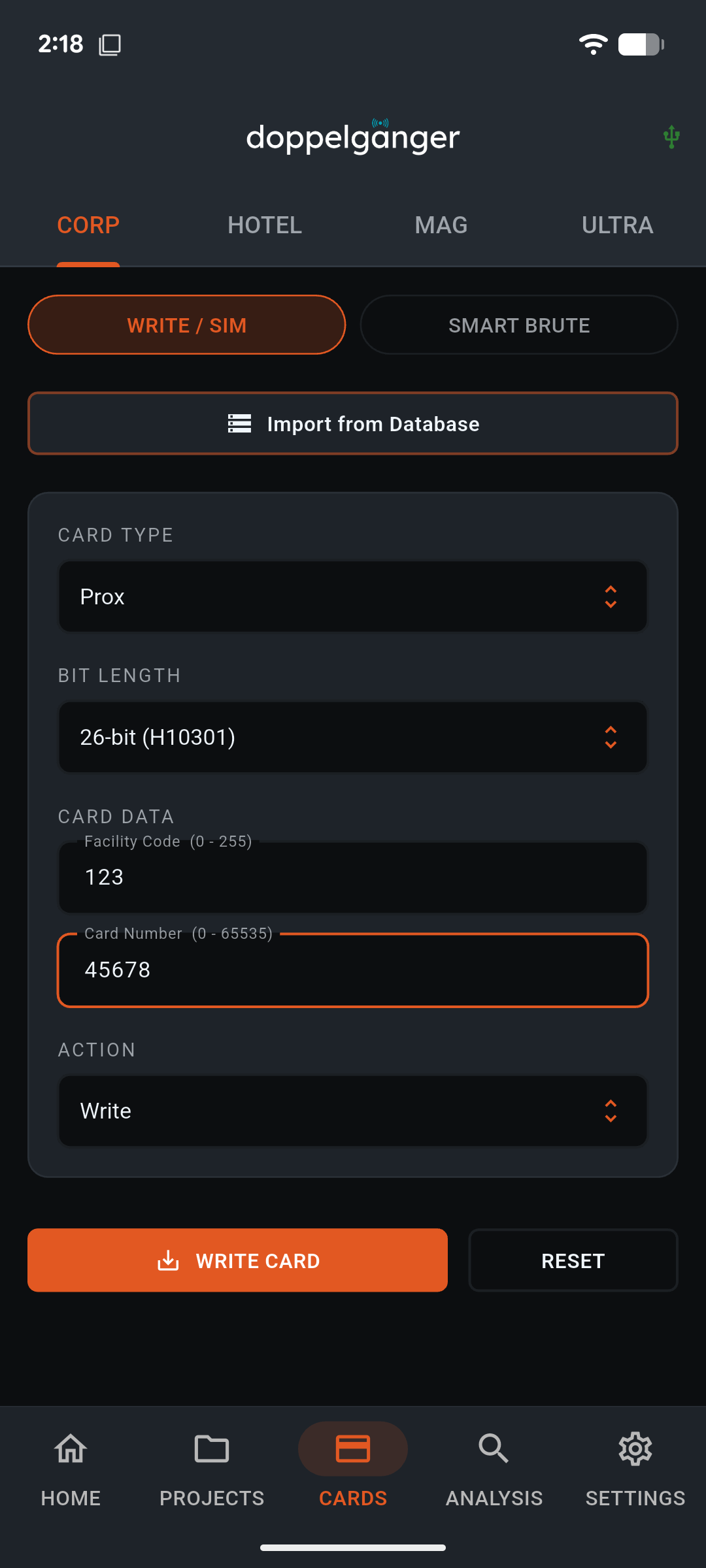
- Import from Database fills this form from a card you captured.
- CARD TYPE, set to Prox.
- CARD DATA, with Facility Code 123 and Card Number 45678.
- WRITE CARD starts the write.
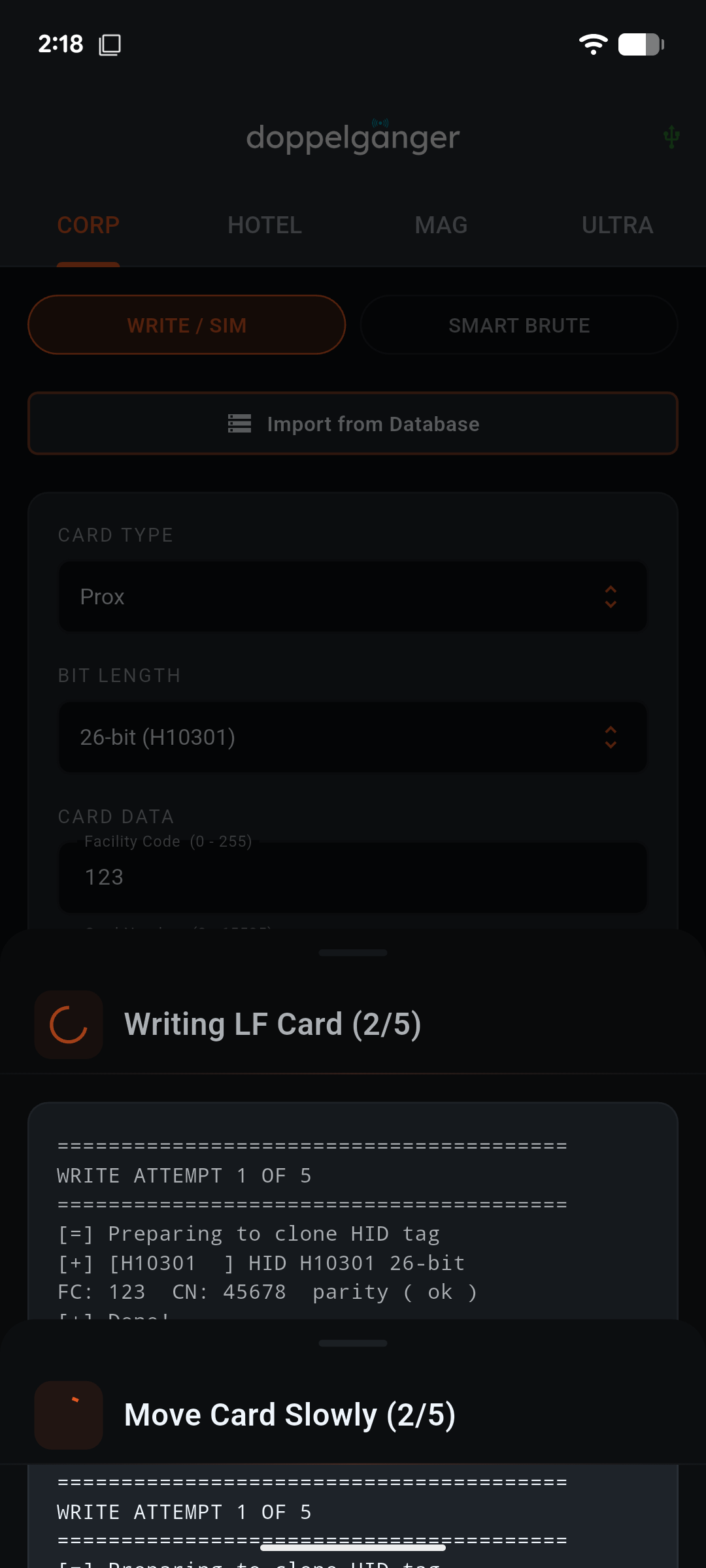
- Writing LF Card, counting attempts out of five.
- The parity check on the credential being written.
- Move Card Slowly, the prompt between attempts.
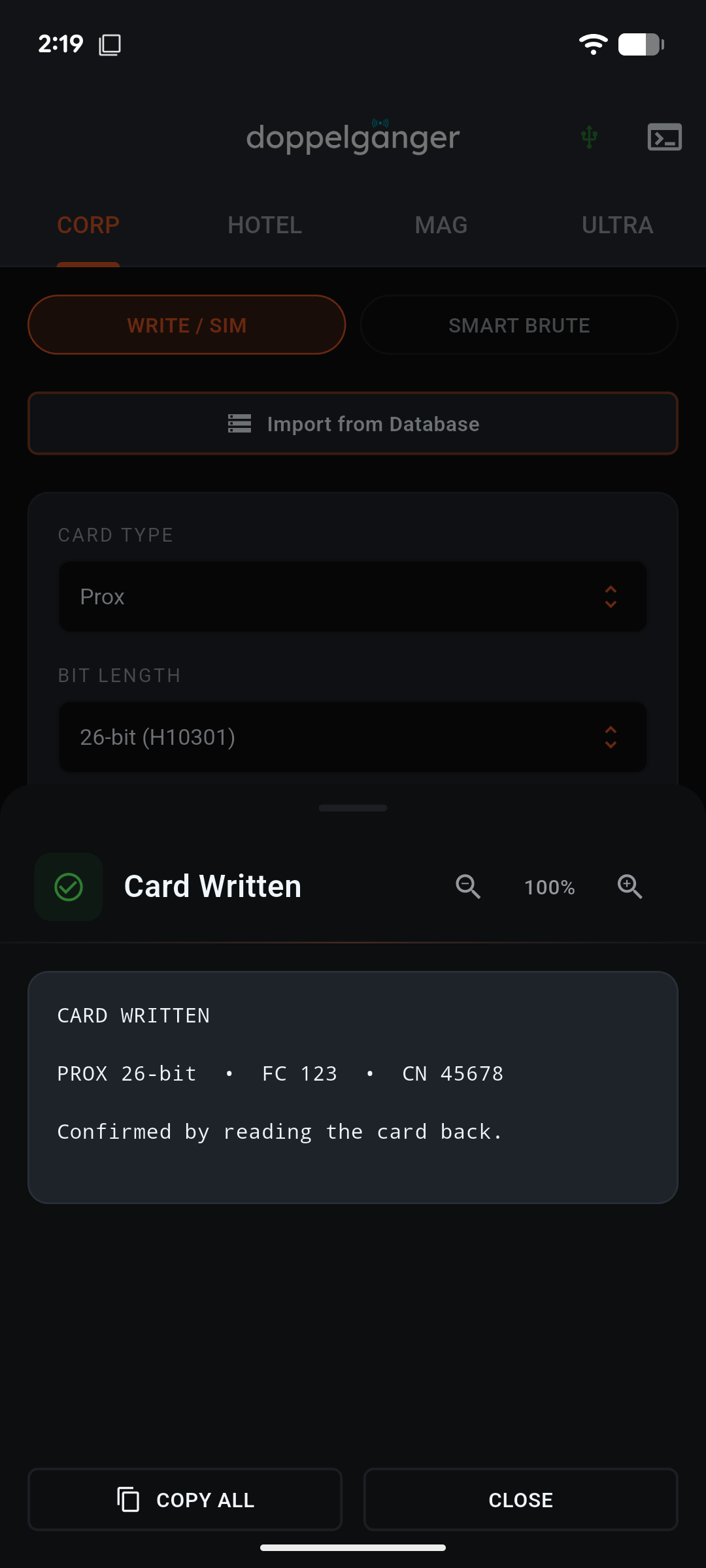
- Card Written, with a green check.
- PROX 26-bit, FC 123, CN 45678, what was written.
- Confirmed by reading the card back.
- Open Cards, the CORP tab, and WRITE / SIM.
- Fill the form. Tap Import from Database and pick the captured card, or pick CARD TYPE and BIT LENGTH and fill in CARD DATA yourself.
- Put the T5577 on the Proxmark antenna.
- Leave ACTION on Write and press WRITE CARD.
- An output sheet opens and reports each attempt. Between attempts it prompts Move Card Slowly. A T5577 takes the write at a particular position over the antenna, and sliding the card through gives it more chances to land.
- The sheet finishes Card Written, naming what it wrote, with the confirmation under it.
The first attempt of the write in the figure printed this.
proxmark3 WRITE ATTEMPT 1 OF 5[=] Preparing to clone HID tag[+] [H10301 ] HID H10301 26-bit FC: 123 CN: 45678 parity ( ok )[+] Done!What a written and verified card looks like
A good write ends Card Written and prints one of two explanations under the card description. They are not the same claim.
| Explanation | What was checked | Which card types reach it |
|---|---|---|
| The tag confirmed it on attempt 2 of 5. Every block was read back off the card and matched. | The write put down every block and then read each one back off the tag to compare. The stronger of the two, and the attempts stop there | AWID, Indala and IO Prox |
| Confirmed by reading the card back. | The Proxmark read the blank again and compared it: the facility code and card number for Prox, Avigilon, AWID and Indala, the hex ID for EM4100 / Net2, and the version, facility code and card number for IO Prox | Prox, Avigilon and EM4100 / Net2, and AWID, Indala or IO Prox when the tag did not confirm the write itself |
A write that cannot be confirmed says WRITE NOT CONFIRMED.
The blank has to be on the antenna before you press WRITE CARD
With nothing on the antenna the attempts run and find no tag. The result sheet says so and does not claim success, but the time is spent.
| Limit | Value |
|---|---|
| Blank | T5577 |
| Write attempts | Up to five by default, stopping early when the tag confirms the write. Change the count under Settings, LF Write Configuration |
Every format the Proxmark writes to a T5577
| CARD TYPE | BIT LENGTH choices |
|---|---|
| Prox | 26-bit (H10301), 28-bit (2804W), 30-bit (ATSW30), 31-bit (ADT31), 33-bit (D10202), 34-bit (H10306), 35-bit (C1k35s), 36-bit (S12906), 37-bit (H10304), 46-bit (H800002), 48-bit (C1k48s) |
| AWID | 26-bit (AWID26), 50-bit (AWID50) |
| Indala | 26-bit (Ind26) |
| Avigilon | 56-bit (avig56) |
| EM4100 / Net2 | No bit length. HEX DATA, entered as ten characters |
| IO Prox | 64-bit (XSF), with Facility Code (0 - 255), Card Number (0 - 65535) and Version (0 - 255). Version is required, and a write without it is refused with Please enter Version. |
The Indala list on this form also offers 27-bit (Ind27) and 29-bit (Ind29). Those two are simulate only on the Proxmark: picking either one takes Write off ACTION, so neither is written to a T5577.
The whole page for this route is the CORP write page on the ATLAS site.
Writing a T5577 with an ATLAS Chameleon Ultra
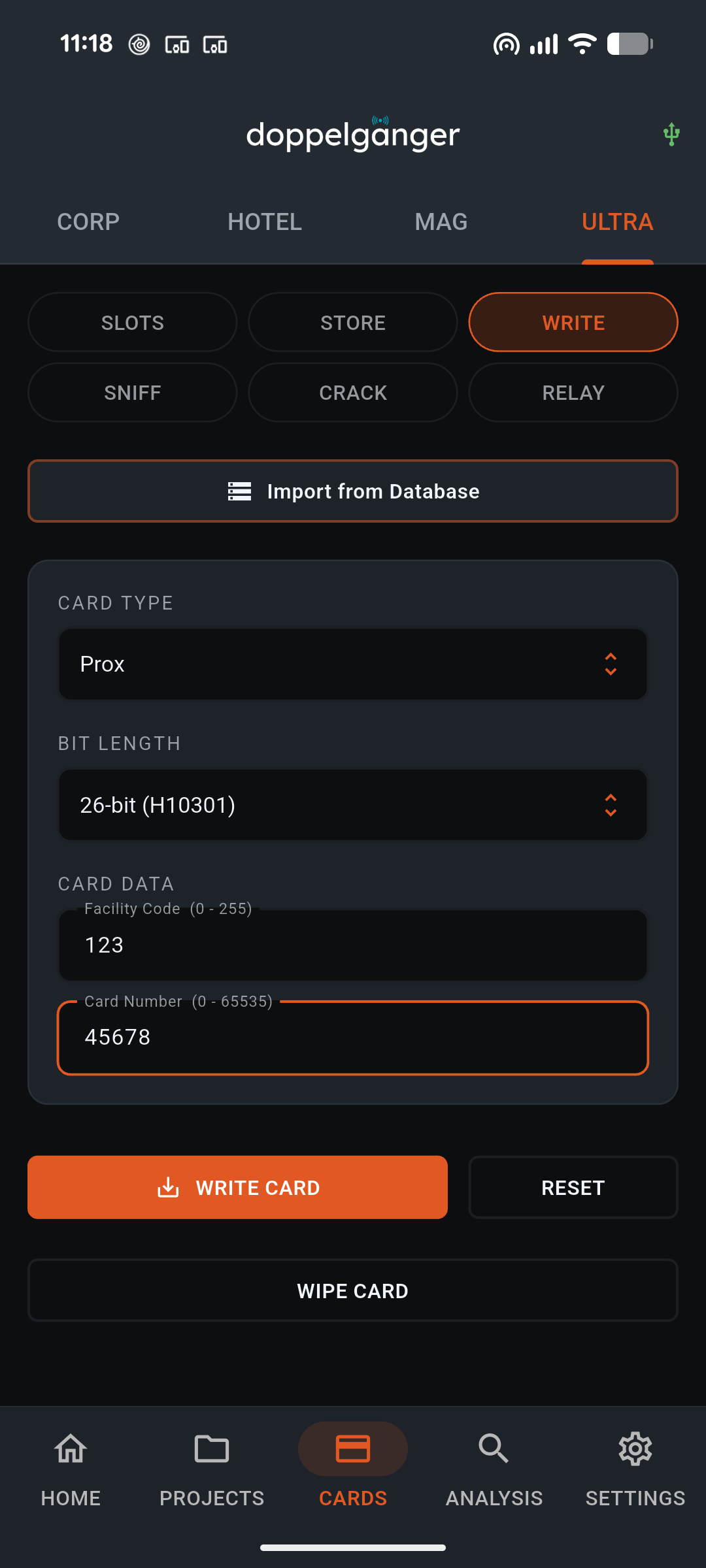
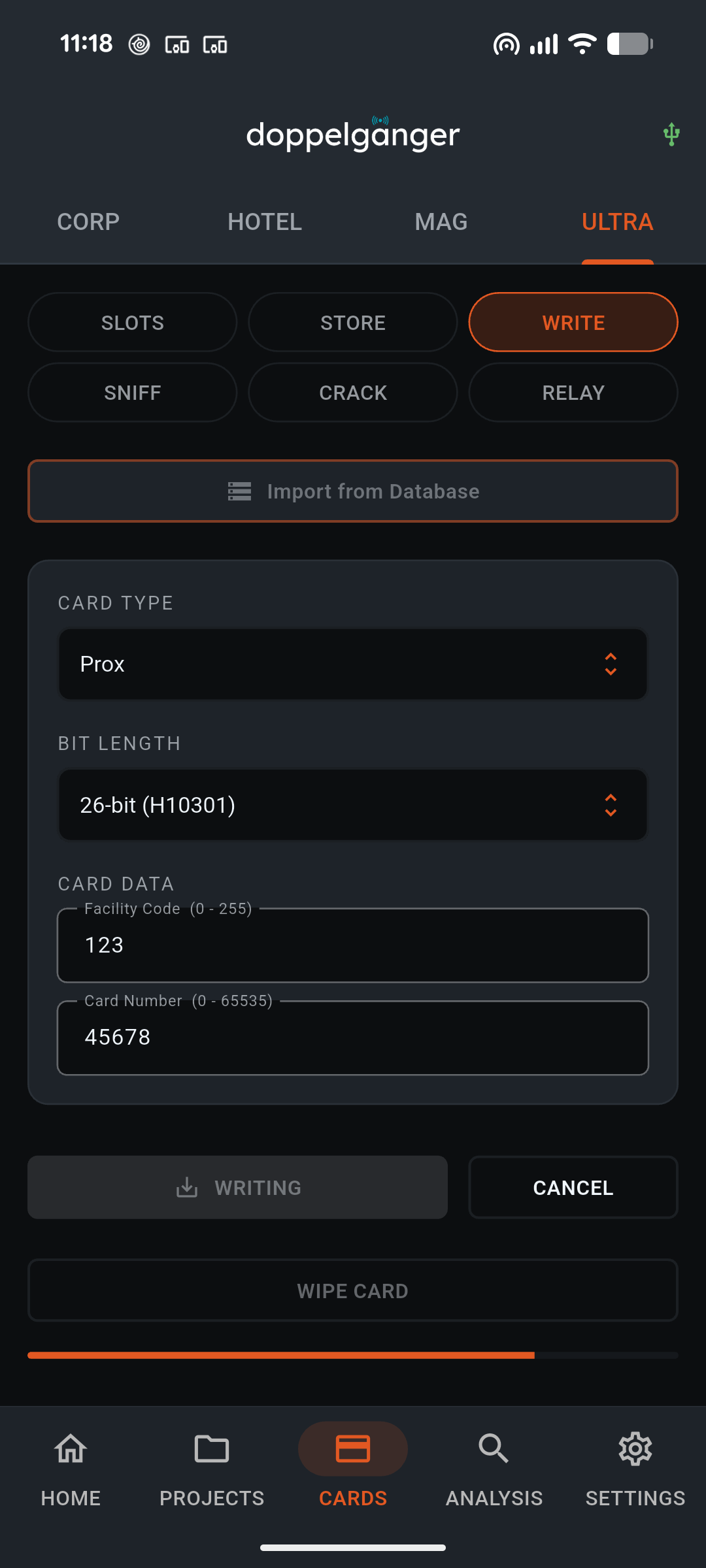
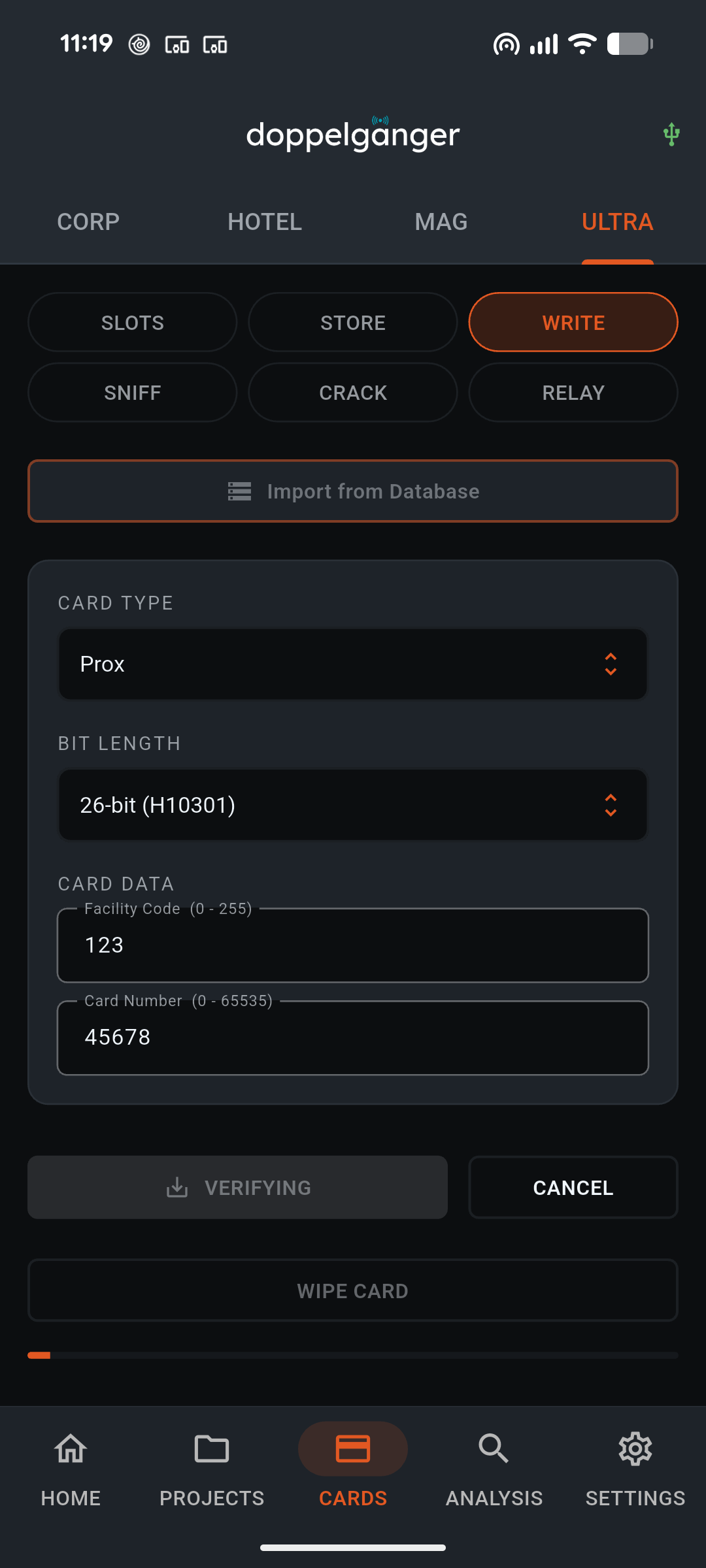
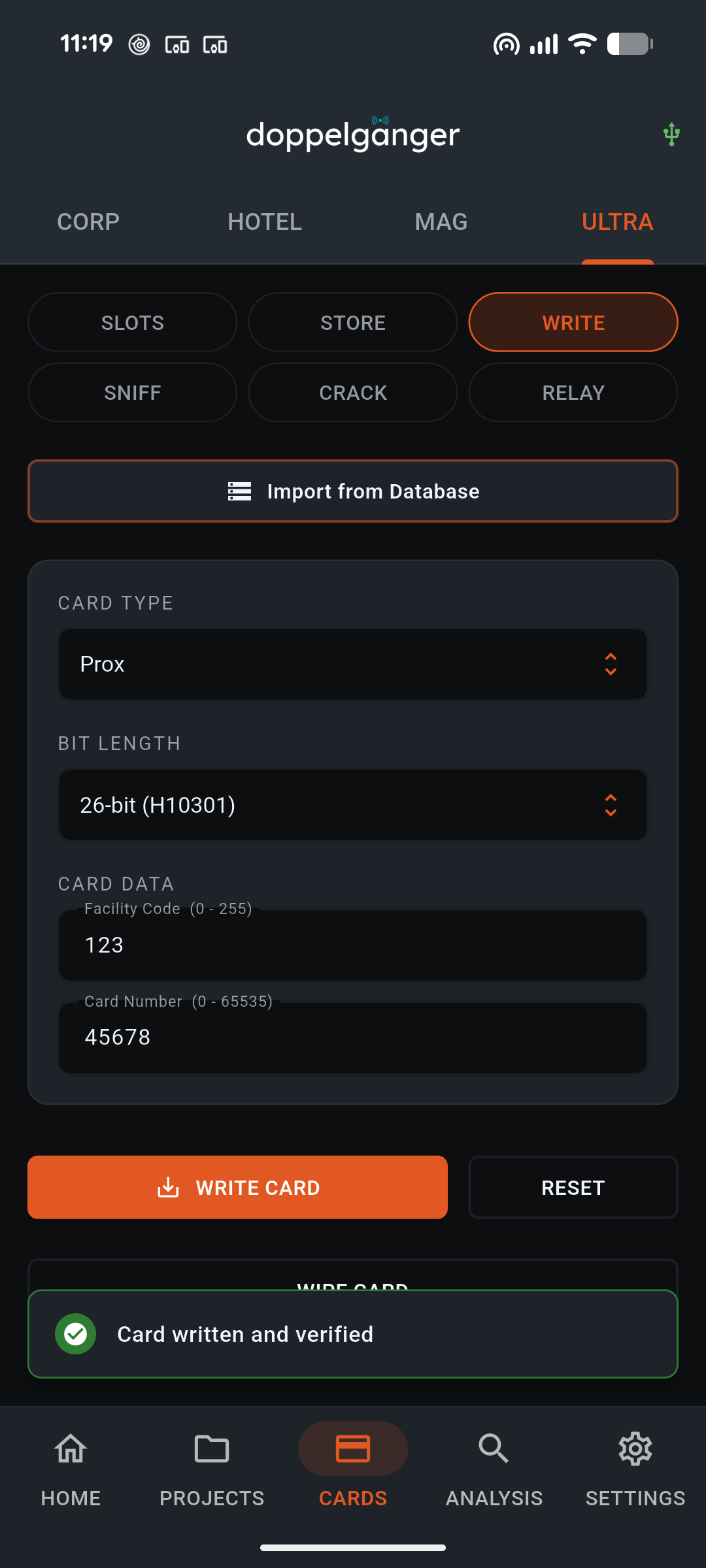
- CARD TYPE, Prox.
- BIT LENGTH, 26-bit (H10301).
- Facility Code 123 and Card Number 45678.
- WRITE CARD.
- WRITING, with CANCEL beside it.
- The WRITING bar, filling for the write.
- VERIFYING, while the ATLAS Chameleon Ultra reads the card back.
- The VERIFYING bar, its own bar, starting from empty.
- WRITE CARD, ready for the next card.
- Card written and verified.
- Connect the ATLAS Chameleon Ultra. WRITE CARD stays gray without one.
- Open Cards, the ULTRA tab, and the WRITE chip.
- Fill the form. Tap Import from Database and pick the captured card, and the form switches CARD TYPE and BIT LENGTH to match, fills the data, and reads Loaded and the record’s format. Or pick CARD TYPE, pick BIT LENGTH if it appears, and fill the card data yourself.
- Check every box.
- Lay the card flat on the ATLAS Chameleon Ultra and hold both still.
- Tap WRITE CARD.
- Keep holding until the message arrives. The control reads WRITING, then VERIFYING, and each stage fills its own progress bar under it.
- Read the message. Card written and verified, or Card repaired, written and verified after a repair, are the only ones that mean the card in your hand carries what you entered.
A T5577 gives no acknowledgment when it is written. So the write is not reported as done until the ATLAS Chameleon Ultra has read the card back and the read matches. That read is the VERIFYING stage, with its own progress bar that starts from empty, and lifting the card when the button changes to VERIFYING is how a good write ends up reported as unverified.
| Stage | The control reads | How long |
|---|---|---|
| Writing | WRITING | About 1.0 to 1.7 seconds, by format |
| Reading back | VERIFYING | Until the card answers, up to about 20 seconds |
What a written and verified card looks like
| Message | What happened | Do this |
|---|---|---|
| Card written and verified | Written, read back, and the read is what was written | Done |
| Card written, not verified | The write ran to its end and no card answered the read back | This is not a failed write. Check the card on a reader, or write again holding still through VERIFYING |
| Card Needs Repair, a dialog | A card answered the read back and did not take the write | REPAIR to wipe it and write again. CANCEL leaves it and reports Write not confirmed |
| Write not confirmed, the card reads differently | The read back found something other than what was written | Write again, or WIPE CARD first |
| Card repaired, written and verified | After REPAIR, the card was wiped, written and read back, and the read is what was written | Done |
| FC must be 0 - the format’s largest facility code and its width, for example FC must be 0 - 255 (8 bits) | The Facility Code is over the format’s range. Nothing was sent | Enter a facility code inside the range in the table below |
| CN must be 0 - the format’s largest card number and its width, for example CN must be 0 - 65535 (16 bits) | The Card Number is over the format’s range. Nothing was sent | Enter a card number inside the range |
| Version must be 0 - 255 (8 bits) | The IO Prox Version is over 255. Nothing was sent | Enter a version from 0 to 255 |
| EM410x / Net2 (5-byte raw hex) needs a 5-byte hex value, or Securakey (12-byte raw hex) needs a 12-byte hex value | The hex box is empty. Nothing was sent | Enter the hex value |
| Hex must be exactly 10 characters (5 bytes), or Hex must be exactly 24 characters (12 bytes) for Securakey | The hex value is the wrong length. Nothing was sent | Enter the full value |
| Hex contains non-hex characters | The hex box holds something other than 0 to 9 and A to F. Nothing was sent | Correct the value |
| Write refused | The device would not start the write | Check the link and try again |
| Write canceled | You tapped CANCEL | Treat the card as written and unverified |
| Write failed | The command did not complete | Check the link |
An empty number box is written as zero
On a T5577 write, an empty Facility Code, Card Number or Version is taken as 0 and written. Nothing stops it, and the card verifies, because it does hold zero. An imported IO Prox record fills Facility Code and Card Number and does not fill Version, so type the version before you write.
While a write runs, RESET is replaced by CANCEL.
| You tap CANCEL during | What happens |
|---|---|
| WRITING | The write already sent runs to its end, so the card is written. The read back is skipped and the message is Write canceled |
| VERIFYING | The read is dropped at once. The card was already written |
WIPE CARD, and a card that needs repair
WIPE CARD, under WRITE CARD and RESET, restores a T5577 to a blank factory card. It has brought back a card an earlier write had left locked. A card whose master key turns test mode off has not been tested. Use it on a card that came back from another cloner, or on a card that will not take a write. No write sends a password to the card.
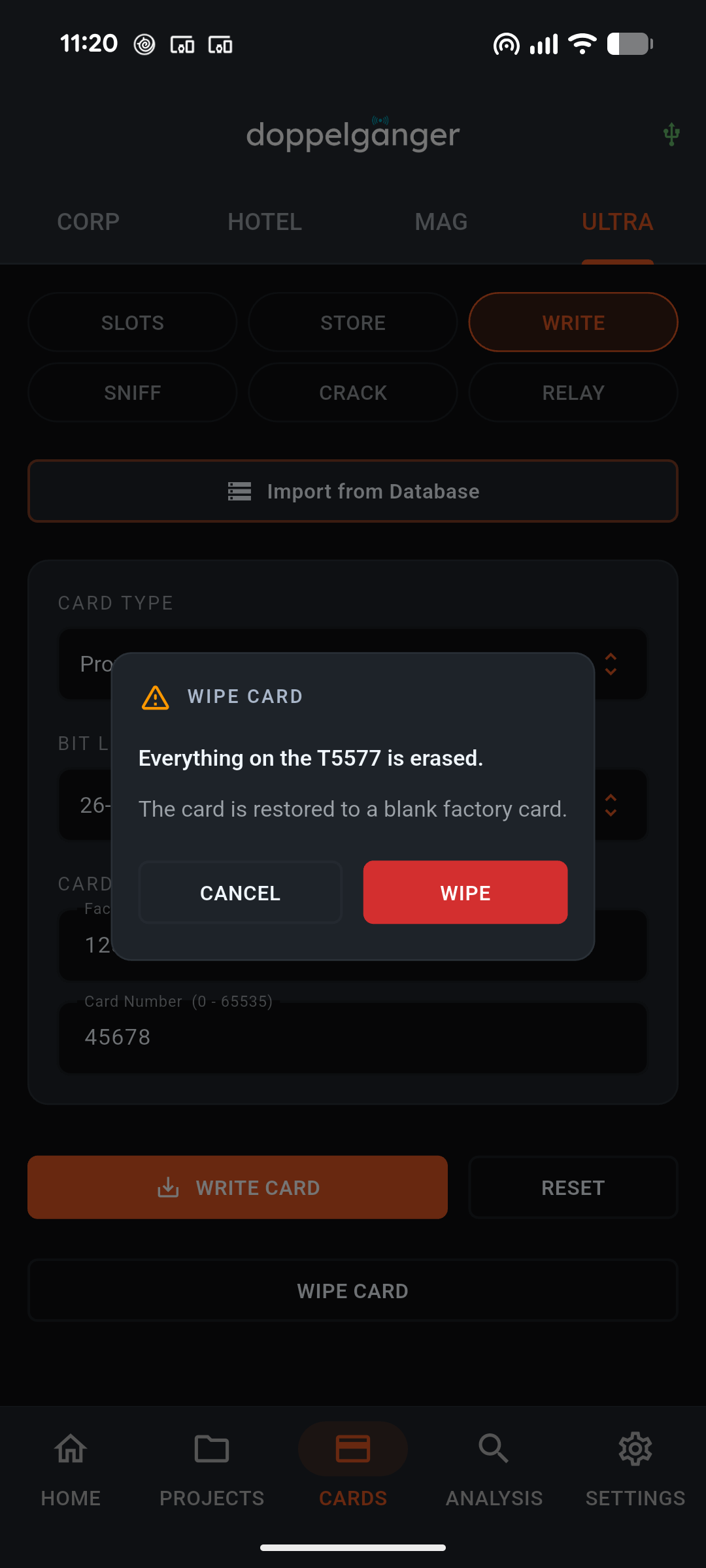
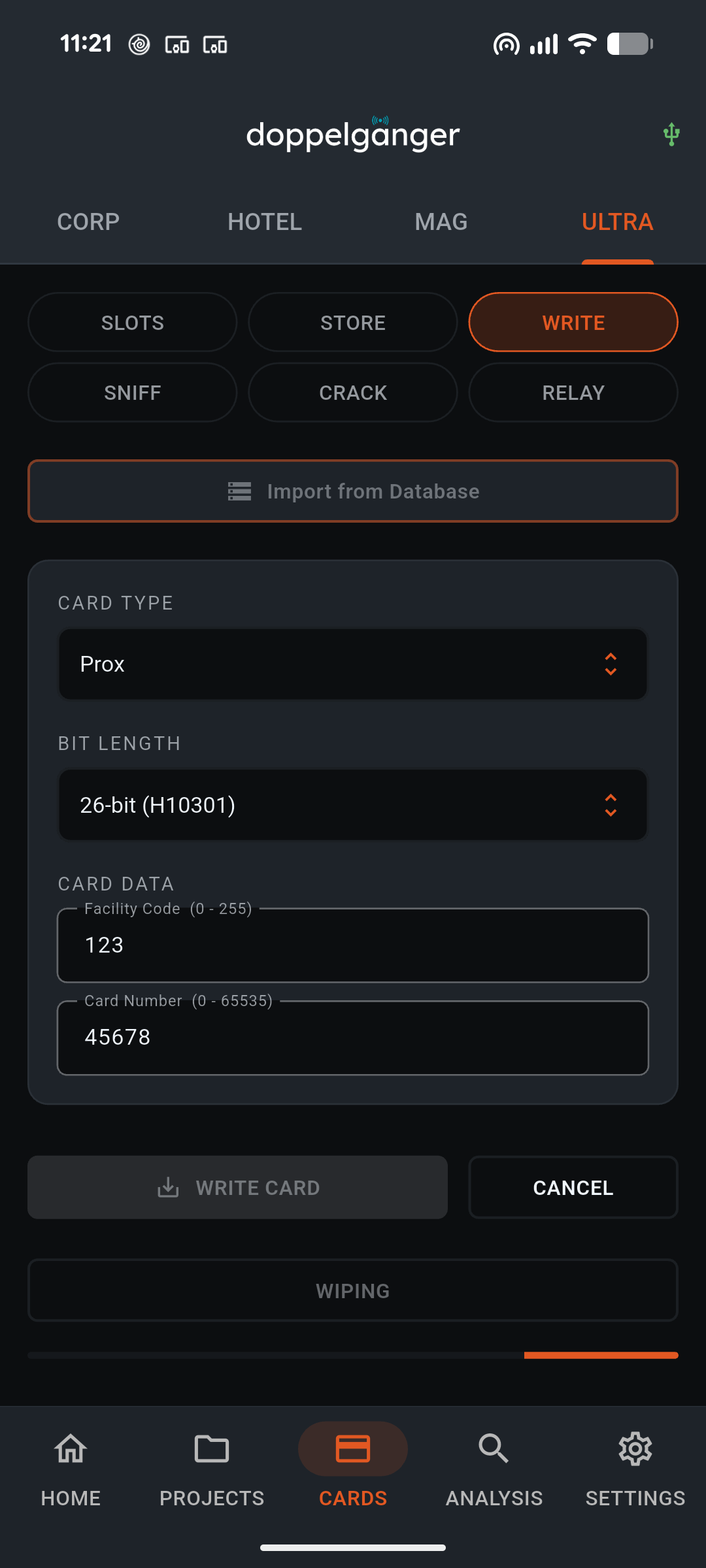
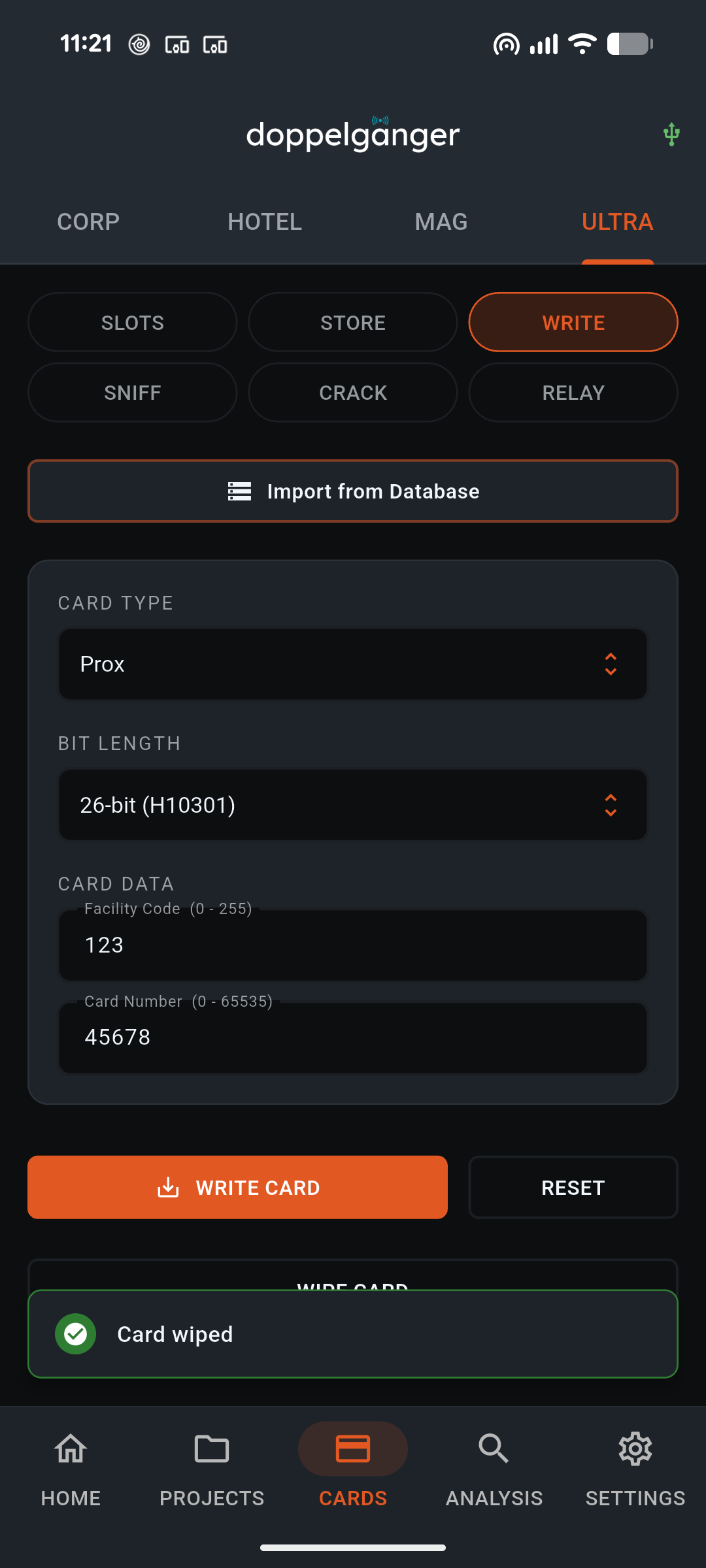
- WIPE CARD.
- Everything on the T5577 is erased.
- CANCEL, or WIPE in red.
- CANCEL, while the wipe runs.
- WIPING.
- WRITE CARD, ready for a credential.
- Card wiped.
| After WIPE | What happened |
|---|---|
| Card wiped | The card reads back as a blank factory card |
| Card not wiped, it still reads | The card still carries a credential after the wipe |
| No card answering | Nothing answered on the ATLAS Chameleon Ultra |
| Wipe refused | The device would not run the wipe |
| Wipe failed | The command did not complete |
A write offers the same thing by itself when the card did not take it. If the read back finds a different credential on the card, or a card that answers and holds nothing readable, Card Needs Repair opens and says which. REPAIR wipes the card and writes the credential again in one pass. It ends Card repaired, written and verified, or No card answering, Repair refused or Card could not be repaired. CANCEL leaves the card and reports Write not confirmed.
| Limit | Value |
|---|---|
| Blank | T5577. It can already hold a credential, and the write replaces it |
| Write, EM410x, Indala 64-bit, IO Prox | About 1.0 second |
| Write, Pyramid | About 1.4 seconds |
| Write, HID frames of 44 bits and up: 46-bit (H800002), 48-bit (C1k48s), 56-bit (avig56) | About 1.7 seconds |
| Write, every other format | About 1.2 seconds |
| Read back | Runs until the card answers, up to about 20 seconds |
| With no device connected | The form and Import from Database work, and WRITE CARD is gray |
The write times are the app’s own estimates and drive the progress bar.
Every format the Chameleon Ultra writes to a T5577
| CARD TYPE | BIT LENGTH | Full name | Facility Code | Card Number |
|---|---|---|---|---|
| EM410x / Net2 | 40-bit (EM410x) | EM410x / Net2 (5-byte raw hex) | Raw hex, 5 bytes, 10 characters | |
| Prox | 26-bit (H10301) | HID H10301 | 0 - 255 | 0 - 65535 |
| Prox | 28-bit (2804W) | 2804W | 0 - 255 | 0 - 32767 |
| Prox | 30-bit (ATSW30) | ATS-W | 0 - 4095 | 0 - 65535 |
| Prox | 31-bit (ADT31) | ADT 31-bit | 0 - 15 | 0 - 8388607 |
| Prox | 32-bit (HCP32) | HCP 32-bit | Not used | 0 - 16383 |
| Prox | 32-bit (HPP32) | HPP 32-bit | 0 - 4095 | 0 - 524287 |
| Prox | 32-bit (Kastle) | Kastle 32-bit | 0 - 255 | 0 - 65535 |
| Prox | 32-bit (Kantech) | Kantech 32-bit | 0 - 255 | 0 - 65535 |
| Prox | 32-bit (Wie32) | Wiegand 32-bit | 0 - 4095 | 0 - 65535 |
| Prox | 33-bit (D10202) | D10202 | 0 - 127 | 0 - 16777215 |
| Prox | 34-bit (H10306) | HID H10306 | 0 - 65535 | 0 - 65535 |
| Prox | 34-bit (N10002) | N10002 | 0 - 65535 | 0 - 65535 |
| Prox | 34-bit (Optus) | Optus 34-bit | 0 - 2047 | 0 - 65535 |
| Prox | 34-bit (SMP) | SMP 34-bit | 0 - 8191 | 0 - 65535 |
| Prox | 34-bit (BQT) | BQT 34-bit | 0 - 255 | 0 - 16777215 |
| Prox | 35-bit (C1k35s) | HID Corporate 1000 (35-bit) | 0 - 4095 | 0 - 1048575 |
| Prox | 36-bit (C15001) | C15001 | 0 - 255 | 0 - 65535 |
| Prox | 36-bit (S12906) | S12906 | 0 - 255 | 0 - 16777215 |
| Prox | 36-bit (Sie36) | Siemens 36-bit | 0 - 262143 | 0 - 65535 |
| Prox | 37-bit (H10320) | HID H10320 (BCD) | Not used | 0 - 99999999 |
| Prox | 37-bit (H10302) | HID H10302 (no FC) | Not used | 0 - 34359738367 |
| Prox | 37-bit (H10304) | HID H10304 | 0 - 65535 | 0 - 524287 |
| Prox | 37-bit (P10004) | P10004 | 0 - 8191 | 0 - 262143 |
| Prox | 37-bit (HGen37) | HID 37-bit Generic | Not used | 0 - 4294967295 |
| Prox | 37-bit (MDI37) | MDI 37-bit | 0 - 15 | 0 - 536870911 |
| Prox | 46-bit (H800002) | HID 800002 | 0 - 16383 | 0 - 1073741823 |
| Prox | 48-bit (C1k48s) | HID Corporate 1000 (48-bit) | 0 - 4194303 | 0 - 8388607 |
| Indala | 26-bit (Ind26) | Indala Wiegand 26-bit | 0 - 4095 | 0 - 4095 |
| Indala | 27-bit (Ind27) | Indala 27-bit | 0 - 8191 | 0 - 16383 |
| Indala | 27-bit (IndASC27) | Indala ASC 27-bit | 0 - 8191 | 0 - 16383 |
| Indala | 27-bit (Tecom27) | Tecom 27-bit | 0 - 2047 | 0 - 65535 |
| Indala | 29-bit (Ind29) | Indala 29-bit | 0 - 8191 | 0 - 65535 |
| Indala | 64-bit (Indala64) | Indala 64-bit (PSK) | 0 - 255 | 0 - 65535 |
| Avigilon | 56-bit (avig56) | Avigilon 56-bit (20+34) | 0 - 1048575 | 0 - 17179869183 |
| AWID | 26-bit (AWID26) | AWID 26-bit | 0 - 255 | 0 - 65535 |
| AWID | 34-bit (AWID34) | AWID 34-bit | 0 - 255 | 0 - 16777215 |
| AWID | 37-bit (AWID37) | AWID 37-bit | 0 - 8191 | 0 - 262143 |
| AWID | 50-bit (AWID50) | AWID 50-bit | 0 - 65535 | 0 - 4294967295 |
| Pyramid | 26-bit (Pyr26) | Pyramid Farpointe 26-bit | 0 - 255 | 0 - 65535 |
| Paradox | 26-bit (Para26) | Paradox FSK 26-bit | 0 - 255 | 0 - 65535 |
| Securakey | 96-bit (SecKey) | Securakey (12-byte raw hex) | Raw hex, 12 bytes, 24 characters | |
| IO Prox | 64-bit (XSF) | IO Prox XSF 64-bit | 0 - 255 | 0 - 65535, and Version 0 - 255 |
A card type with one format shows no BIT LENGTH dropdown, so that row’s bit length is not bolded: it is the format the form writes, not a label on screen. The four Casi-Rusco formats are not on this page of the app. The whole page for this route is the ULTRA write page on the ATLAS site.
Without ATLAS, from a computer
A Proxmark3 client on a computer writes the same card. This is the route with typing in it: you read the values off the reader’s page and enter them yourself.
| Captured as | Command |
|---|---|
| HID Prox, by facility code and card number | lf hid clone -w H10301 --fc 113 --cn 42683 |
| HID Prox, by the raw hex value | lf hid clone -r 2004E34D77 |
| Indala, by facility code and card number | lf indala clone --fc 113 --cn 42683 |
Verify every write. lf hid reader reads an HID Prox card back, and lf indala reader reads an Indala card back. Doppelgänger Assistant builds and runs those commands for you from a bit length, a facility code and a card number.
What is in the pack
The listing is a pack of blank T5577 cards. The photograph shows plain white cards with no printing on the visible face.
Specifications
| Frequency | 125kHz |
| Chip | T5577 |
| Rewritable | Yes |
| Card data the store lists it for | Prox, EM, AWID, Indala |
Intended use
PPE products are professional tools for security practitioners working under contract or in the course of their employment, with the authorization of the site's owner. They are used to perform security audits, to help integrators confirm that an installation is secure, and to audit the work integrators and installers have done, so that flaws are found and remediated before someone with bad intentions finds them. They are not research devices, they are not sold as research devices, and they are not for any illegal or unauthorized purpose.
The manufacturers whose readers and credentials these products are used with make very secure products when those products are implemented properly. An audit shows where an installation falls short of that, so it can be corrected.