Card Formats
Product documentation menu
Every card technology the readers read, every frame length Doppelgänger Core and Stealth name, and all 44 formats Decode can show a read as, with where the facility code and card number sit in each.
You come away from a site with a list of reads: a bit length, a facility code and a card number for each. What you need is a card that opens the door, and the numbers alone do not make one. The same 37 bits are one facility code and card number as H10304 and a single long card number as H10302. The same 26 bit read is a Prox credential off one reader and an iCLASS credential off another, and those are written to different blanks.
This page is the reference for that decision. It lists every card technology the readers on the front read, every frame length the firmware names and the name it logs, and every format the reader’s own Decode can show a read as, bit by bit.
| You want to know | Go to |
|---|---|
| which reader reads which card technology | The reader on the front decides the technology |
| what name a read of a given length is logged under | The name a read is logged under |
| where a format keeps its facility code and card number | All 44 formats, by bit length |
| why a 32 bit read has no facility code | 32 bits: a card, or a card serial |
| what a keypad sends | Keypad frames |
| what a Paxton card sends | Paxton: the 75 bit frame |
| why a read says Unknown | Unknown, and the padded 48 bit frame |
The reader on the front decides the technology
The board does not read cards. The reader on the front does, and hands the board the frame it would have handed the door controller. A read lands as a bit length, a facility code and a card number, and nothing in it says what technology it came off. The reader does, so record which reader took which reads.
| Reader on the front | Technology it reads |
|---|---|
| HID MaxiProx 5375 | 125 kHz: every HID card and tag, in any format up to 85 bits. ProxCard II, ISOProx II, DuoProx II, Smart ISOProx II, Smart DuoProx II, ProxCard Plus, ProxKey II, MicroProx Tag, the ProxPass active vehicle tag, and the 125 kHz side of the HID Proximity & MIFARE Card |
| HID Indala ASR-620++ | 125 kHz Indala. The Indala formats need an Indala reader |
| HID iCLASS SE R90 | 13.56 MHz only: HID iCLASS Seos, iCLASS SE, iCLASS SR and standard iCLASS, MIFARE Classic and MIFARE DESFire EV1 cards that carry an SIO, and the card serial number of a MIFARE Classic or MIFARE DESFire card that does not |
| Paxton P200 Dual Mode | Paxton Net2. The 75 bit frame is Paxton only |
| HID Signo, in a Stealth or MFAS decoy | 125 kHz Prox, 13.56 MHz iCLASS Legacy, iCLASS SE, iCLASS SR and Seos, and DESFire EV1 with SIO and DESFire EV3 with SIO, both returned as the credential inside the card and not as its UID |
| What the reader on the front does with the card | What the board logs |
|---|---|
| reads the credential | the credential the door acts on: its format, its facility code and its card number |
| sees the card but cannot open it | the card’s serial and nothing else, as a 32 bit card serial |
A 26 bit read off a MaxiProx is almost certainly HID Prox at 125 kHz. The same 26 bit read off an iCLASS R90SE is an iCLASS credential, and writing it back means writing to an iCLASS card, not a T5577.
The name a read is logged under
A frame does not say which format it is, so the firmware reads each length one way and logs it under one name. That name is what the Format column on the reader’s Cards tab shows and what cards.csv holds.
Reader Mode Wiegand (HID). A key press is a frame of its own, and every other length is a card.
| Bits | Logged as | What it is | Facility code and card number |
|---|---|---|---|
| 1 to 3 | nothing | line noise. The shortest thing a reader sends is a 4 bit key | never logged |
| 4 | PIN | one key pressed on the reader’s keypad, one frame for each key | the key |
| 26 | H10301 | HID H10301 | decoded |
| 27 | ind27 | Indala 27 | decoded |
| 28 | 2804W | 2804 Wiegand | decoded |
| 29 | ind29 | Indala 29 | decoded |
| 30 | ATSW30 | ATS Wiegand | decoded |
| 31 | ADT31 | HID ADT | decoded |
| 32 | WIE32 | Wiegand 32 | decoded |
| 32 | PIV/MiFare/FASC-N | a card serial | the serial, with no facility code. The page shows the read as Serial |
| 33 | D10202 | HID D10202 | decoded |
| 34 | H10306 | HID H10306 | decoded |
| 35 | C1k35s (C-1000) | HID Corporate 1000, 35 bit | decoded. The page shows C1k35s |
| 36 | S12906 | HID Simplex | decoded |
| 37 | H10304 | HID H10304 | decoded |
| 38 | BQT38 | BQT 38 | decoded |
| 39 | PW39 | Pyramid 39 | decoded |
| 40 | P10001, Verkada40, BC40 or Casi40 | P10001, Verkada 40, BC 40 or Casi-Rusco 40 | decoded. The frame’s own check bits say which of the four it is |
| 46 | H800002 | HID H800002 | decoded |
| 48 | C1k48s (C-1000) | HID Corporate 1000, 48 bit | decoded. The page shows C1k48s |
| 50 | AWID50 | AWID 50 | decoded |
| 56 | Avig56 | Avigilon 56 | decoded |
| 64 | H10309 | HID H10309 | named and not decoded. Both numbers stay at 0 |
| 80 to 100, on a Stealth | C1k48s (C-1000) | a 48 bit Corporate 1000 card that arrived with more than 30 zeros ahead of it and 40 to 56 bits after them | decoded from the last 48 bits, and shown as 48 bits |
| any other length | Unknown | a frame of a length the firmware has no name for | not decoded. The bit length and the bits are kept, up to 100 bits |
Reader Mode Clock and Data (Paxton). The card and the keypad each have a frame of their own, and nothing else is completed as a read.
| Bits | Logged as | What it is | What is kept |
|---|---|---|---|
| 75 | Net2/EM | a Paxton Net2 card or fob | the card number, with no facility code. The page shows the read as Paxton |
| 55 or 56 | PIN | a key pressed on a Paxton keypad | the key |
The two modes never overlap. A 56 bit frame from a Wiegand reader is always a card, Avig56, and a keypad frame from a Paxton reader is never taken for one.
All 44 formats, by bit length
The name a read is logged under is one reading of its length. Decode, on the reader’s own page, shows the same bits as every format of that length. It knows 44 formats, and this is all of them.
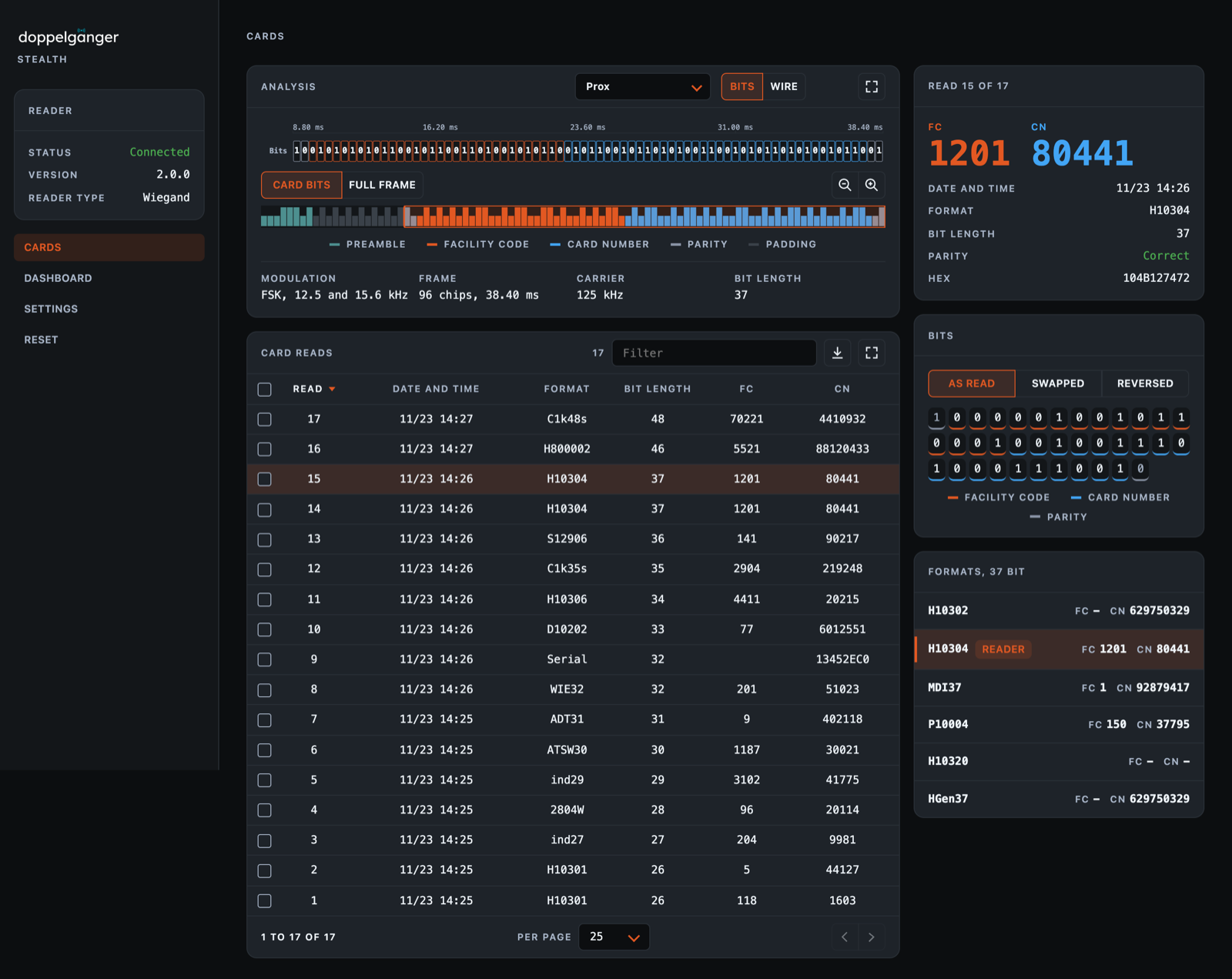
- FC and CN, as the format the reader logged gives them.
- Parity, Correct for H10304.
- H10304, marked Reader: the name this read was logged under.
- HGen37, the last of the six 37 bit formats.
| Bits | Logged as | Decode lists | How many |
|---|---|---|---|
| 26 | H10301 | H10301, AWID26, ind26 | 3 |
| 27 | ind27 | ind27, indasc27, Tecom27 | 3 |
| 28 | 2804W | 2804W | 1 |
| 29 | ind29 | ind29 | 1 |
| 30 | ATSW30 | ATSW30 | 1 |
| 31 | ADT31 | ADT31 | 1 |
| 32 | WIE32 | WIE32, Kantech, Kastle, EM410x, HCP32, HPP32 | 6 |
| 33 | D10202 | D10202 | 1 |
| 34 | H10306 | H10306, BQT34, N10002, Optus34, SMP34 | 5 |
| 35 | C1k35s | C1k35s | 1 |
| 36 | S12906 | S12906, C15001, Sie36 | 3 |
| 37 | H10304 | H10304, H10302, MDI37, P10004, H10320, HGen37 | 6 |
| 38 | BQT38 | BQT38, ISCS | 2 |
| 39 | PW39 | PW39 | 1 |
| 40 | P10001, Verkada40, BC40 or Casi40 | P10001, BC40, Casi40, Verkada40 | 4 |
| 46 | H800002 | H800002 | 1 |
| 48 | C1k48s | C1k48s | 1 |
| 50 | AWID50 | AWID50 | 1 |
| 56 | Avig56 | Avig56, IR56 | 2 |
| 64 | H10309 | nothing. The read is named and its bits are shown | 0 |
| 75 | Net2/EM | nothing. The read is shown as a Paxton card | 0 |
Where each format keeps its fields
Bit 0 is the first bit the reader sends. A field written 1 to 8, 8 bits starts at bit 1 and ends at bit 8, most significant bit first. A scattered field lists its bits in the order they are read, most significant first. The Parity column says what the Parity row in Decode can check for that format: a count of parity bits, None for a format that has none, or Not checked.
| Bits | Format | Logged under this name | Facility code bits | Card number bits | Other fields | Parity checks |
|---|---|---|---|---|---|---|
| 26 | H10301 | yes | 1 to 8, 8 bits | 9 to 24, 16 bits | 2 parity bits | |
| 26 | AWID26 | no, Decode only | 1 to 8, 8 bits | 9 to 24, 16 bits | 2 parity bits | |
| 26 | ind26 | no, Decode only | 1 to 12, 12 bits | 13 to 24, 12 bits | 2 parity bits | |
| 27 | ind27 | yes | 0 to 12, 13 bits | 13 to 26, 14 bits | None | |
| 27 | indasc27 | no, Decode only | 13 scattered bits: 9, 4, 6, 5, 0, 7, 19, 8, 10, 16, 24, 12, 22 | 14 scattered bits: 26, 1, 3, 15, 14, 17, 20, 13, 25, 2, 18, 21, 11, 23 | None | |
| 27 | Tecom27 | no, Decode only | 11 scattered bits: 15, 19, 24, 23, 22, 18, 6, 10, 14, 3, 2 | 16 scattered bits: 0, 1, 13, 12, 9, 26, 20, 16, 17, 21, 25, 7, 8, 11, 4, 5 | None | |
| 28 | 2804W | yes | 4 to 11, 8 bits | 12 to 26, 15 bits | 3 parity bits | |
| 29 | ind29 | yes | 0 to 12, 13 bits | 13 to 28, 16 bits | None | |
| 30 | ATSW30 | yes | 1 to 12, 12 bits | 13 to 28, 16 bits | 2 parity bits | |
| 31 | ADT31 | yes | 1 to 4, 4 bits | 5 to 27, 23 bits | None | |
| 32 | WIE32 | yes | 4 to 15, 12 bits | 16 to 31, 16 bits | None | |
| 32 | Kantech | no, Decode only | 7 to 14, 8 bits | 15 to 30, 16 bits | None | |
| 32 | Kastle | no, Decode only | 7 to 14, 8 bits | 15 to 30, 16 bits | issue level, 2 to 6, 5 bits | 2 parity bits |
| 32 | EM410x | no, Decode only | none | 0 to 31, 32 bits | None | |
| 32 | HCP32 | no, Decode only | none | 11 to 24, 14 bits | None | |
| 32 | HPP32 | no, Decode only | 1 to 12, 12 bits | 13 to 31, 19 bits | None | |
| 33 | D10202 | yes | 1 to 7, 7 bits | 8 to 31, 24 bits | 2 parity bits | |
| 34 | H10306 | yes | 1 to 16, 16 bits | 17 to 32, 16 bits | 2 parity bits | |
| 34 | BQT34 | no, Decode only | 1 to 8, 8 bits | 9 to 32, 24 bits | 2 parity bits | |
| 34 | N10002 | no, Decode only | 1 to 16, 16 bits | 17 to 32, 16 bits | 2 parity bits | |
| 34 | Optus34 | no, Decode only | 22 to 32, 11 bits | 1 to 16, 16 bits | None | |
| 34 | SMP34 | no, Decode only | 1 to 13, 13 bits | 17 to 32, 16 bits | issue level, 14 to 16, 3 bits | None |
| 35 | C1k35s | yes | 2 to 13, 12 bits | 14 to 33, 20 bits | 3 parity bits | |
| 36 | S12906 | yes | 1 to 8, 8 bits | 11 to 34, 24 bits | issue level, 9 to 10, 2 bits | 2 parity bits |
| 36 | C15001 | no, Decode only | 11 to 18, 8 bits | 19 to 34, 16 bits | OEM code, 1 to 10, 10 bits | 2 parity bits |
| 36 | Sie36 | no, Decode only | 1 to 18, 18 bits | 19 to 34, 16 bits | 2 parity bits | |
| 37 | H10304 | yes | 1 to 16, 16 bits | 17 to 35, 19 bits | 2 parity bits | |
| 37 | H10302 | no, Decode only | none | 1 to 35, 35 bits | 2 parity bits | |
| 37 | MDI37 | no, Decode only | 3 to 6, 4 bits | 7 to 35, 29 bits | 2 parity bits | |
| 37 | P10004 | no, Decode only | 1 to 13, 13 bits | 14 to 31, 18 bits | None | |
| 37 | H10320 | no, Decode only | none | 1 to 32, 8 decimal digits of 4 bits each | Not checked | |
| 37 | HGen37 | no, Decode only | none | 4 to 35, 32 bits | 3 parity bits | |
| 38 | BQT38 | yes | 24 to 36, 13 bits | 1 to 19, 19 bits | issue level, 20 to 23, 4 bits | 2 parity bits |
| 38 | ISCS | no, Decode only | 5 to 14, 10 bits | 15 to 36, 22 bits | 2 parity bits | |
| 39 | PW39 | yes | 1 to 17, 17 bits | 18 to 37, 20 bits | 2 parity bits | |
| 40 | P10001 | yes, by the check bits | 4 to 15, 12 bits | 16 to 31, 16 bits | None | |
| 40 | BC40 | yes, by the check bits | 7 to 18, 12 bits | 19 to 37, 19 bits | OEM code, 0 to 6, 7 bits | 1 parity bit |
| 40 | Casi40 | yes, by the check bits | none | 1 to 38, 38 bits | None | |
| 40 | Verkada40 | yes, by the check bits | 1 to 10, 10 bits | 11 to 38, 28 bits | 2 parity bits | |
| 46 | H800002 | yes | 1 to 14, 14 bits | 15 to 44, 30 bits | 2 parity bits | |
| 48 | C1k48s | yes | 2 to 23, 22 bits | 24 to 46, 23 bits | 3 parity bits | |
| 50 | AWID50 | yes | 1 to 16, 16 bits | 17 to 48, 32 bits | 2 parity bits | |
| 56 | Avig56 | yes | 1 to 20, 20 bits | 21 to 54, 34 bits | 2 parity bits | |
| 56 | IR56 | no, Decode only | 0 to 23, 24 bits | 24 to 55, 32 bits | None |
| Something in the table | What it means |
|---|---|
| Facility code bits reading none | the format has no facility code. Decode shows a dash for FC |
| An issue level | Decode shows it as an Issue Level row, and beside the format’s name on the Formats list |
| An OEM code | part of the format’s layout. Decode does not show it |
H10320 | its card number is eight decimal digits of four bits each. A group that is not a digit shows as a dash |
AWID26 | the H10301 layout on a different card. A 26 bit frame that is one is always the other, with the same numbers. Only the card in hand says which |
H10306 and N10002 | one layout under two names. They always give the same numbers |
BQT38 and ISCS | both keep a parity bit at each end of the frame, and each counts its own over different bits. The reader checks neither and logs every 38 bit frame as BQT38 |
EM410x | the 32 bits as one number |
H10302, HCP32, H10320, HGen37 | marked unverified in the reader’s own format table: no reference frame of that format stands behind the layout. Treat numbers read under them as a lead to confirm against a known card |
What Parity tells you
| Parity reads | What it means | How to use it |
|---|---|---|
| Correct | the format has parity bits and they come out right for this frame | a strong sign the read is this format |
| Incorrect | the format has parity bits and they come out wrong | the read is very likely not this format, or its bits are swapped |
| None | the format has no parity bits, so it fits any frame of its length | a possibility, never evidence |
| Not checked | the page holds no parity rule for the format | judge it by the numbers alone |
32 bits: a card, or a card serial
A 32 bit read is either a card’s own numbers or a card serial, and the reader logs it as one or the other. Logged as WIE32, it shows a facility code and a card number. Logged as a card serial, it shows as Serial, with the serial in their place.
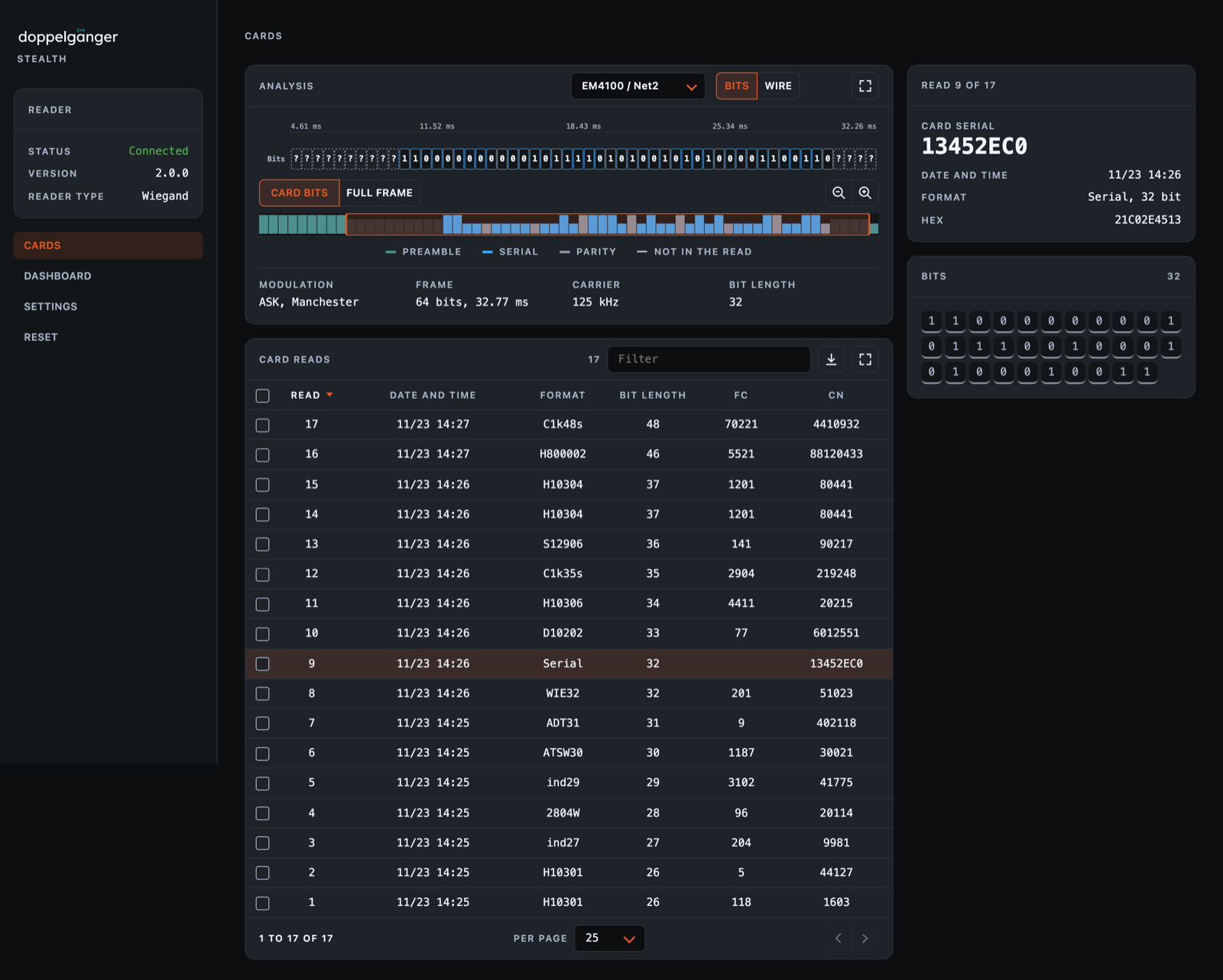
- Card Serial, in place of a facility code and card number.
- Format, Serial, 32 bit, and the Hex the reader logged.
- The 32 bits, with no fields to color.
- Read 9 in the table, with FC empty.
| For a 32 bit read | Decode offers | Analysis offers |
|---|---|---|
logged as WIE32 | all six 32 bit formats: WIE32, Kantech, Kastle, EM410x, HCP32, HPP32 | iCLASS Legacy, iCLASS SE, iCLASS SR, HID Seos, MIFARE DESFire and Prox |
| logged as a serial | no Formats list. The serial, the hex and the bits | MIFARE Classic, PIV, MIFARE DESFire and EM4100 / Net2 |
A reader that sends 32 bits sends four bytes, which is the whole of a four byte serial and only the start of a seven byte one. That is why Analysis says of MIFARE DESFire, 7 byte UID, the read carries 4.
The reader on the front tells you which it is. A 125 kHz reader does not hand over smart card serials, so a 32 bit read from one is a card’s numbers, whichever name it is logged under.
64 bits: named and not decoded
A 64 bit read is logged as H10309 and nothing more. The firmware names the length and works out no numbers for it, so the facility code and the card number stay at 0. The bit length and every bit are kept, which is enough to report that the format is in use at the site. Decode has no 64 bit format, so the page shows the name and the bits.
Keypad frames
A keypad sends its key presses down the same wires as a card, and the two kinds of reader send them differently. The two never share a length.
| Reader Mode | Bits | Logged as | What it is |
|---|---|---|---|
| Wiegand (HID) | 4 | PIN | one key pressed on the reader’s keypad, one frame for each key |
| Clock and Data (Paxton) | 55 or 56 | PIN | a key pressed on a Paxton keypad |
| How a PIN is kept and shown | |
|---|---|
| In the log | one line for each key, in the order they were pressed |
| On the reader’s Cards tab | keys pressed one after another are one read, the whole PIN. Format reads Keypad and CN reads PIN and the digits |
| Under Analysis | Bits is switched off for a PIN, and the panel opens on Wire: every key drawn in turn, with Keys and Bits per Key in the readings |
| Under Decode | the PIN alone. A key press has no format to decode as |
Paxton: the 75 bit frame
A Paxton reader does not send Wiegand. It clocks its bits out, one wire carrying a clock and the other the bit, and the board reads it with Reader Mode on Clock and Data (Paxton) or Auto. A Net2 card or fob is one 75 bit frame, logged as Net2/EM, with a card number and no facility code.
| Part of the frame | Bits | What it holds |
|---|---|---|
| Leading zeros | 10 | zeros |
| Start | 5 | the character B |
| Card number | 40 | eight digits, five bits each |
| End | 5 | the character F |
| Check | 5 | a check character worked from the ten before it |
| Trailing zeros | 10 | zeros |
Each of the eleven characters is four bits, least significant first, followed by one odd parity bit.
| On the reader’s page | What a Paxton read shows |
|---|---|
| Cards | Format Paxton, Bit Length 75, an empty FC, and the card number under CN |
| Analysis, Bits | the 75 bits colored as Leading Zeros, Start and End, Card Number and Parity, with a Decoded row holding the eight digits. Does not decode when the frame is damaged |
| Analysis, Wire | the frame on CLK and DATA, with Interface Clock and Data, a Frame row reading B, the digits and F, and the Clock Period |
| Decode | the card number and the bits. There is no other format for a 75 bit frame |
The cards a reader acts on, the reset card and the stealth card, are entered for a Paxton reader as one HEX Value of 10 hex characters in place of a bit length, facility code and card number.
Unknown, and the padded 48 bit frame
A frame of any length the firmware has no name for is logged as Unknown. It is still captured: the bit length and the bits are kept, up to 100 bits, so a format with no name here is recorded and not dropped. The numbers are not worked out, and both stay at 0.
One to three pulses is line noise and is never logged. The shortest thing a reader sends is a 4 bit key.
The Stealth firmware has one rule the Core does not. Some readers send a 48 bit Corporate 1000 card with a run of extra zeros ahead of it, and the Stealth recognizes the shape.
| The padded 48 bit rule, on a Stealth | |
|---|---|
| The frame is | 80 to 100 bits long |
| It starts with | more than 30 zeros |
| After the zeros | 40 to 56 bits remain |
| Logged as | C1k48s (C-1000) |
| Decoded from | the last 48 bits |
| Bit length shown | 48 |
| On a Core | the same frame is Unknown, at its full length |
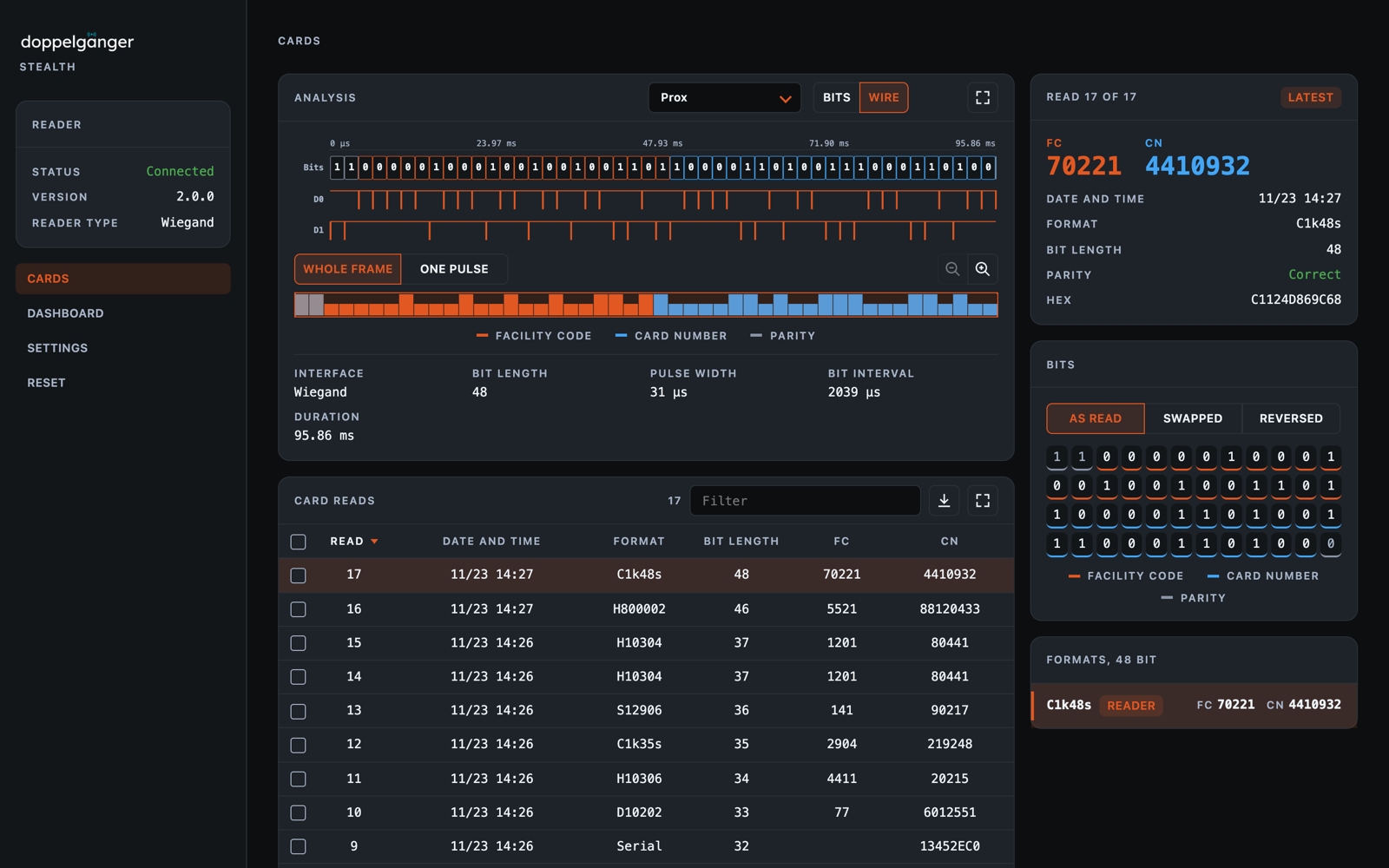
- FC 70221 and CN 4410932.
- Format C1k48s and Bit Length 48.
- Read 17 in the table, logged as C1k48s.
- C1k48s, the one 48 bit format, marked Reader.
Decode saves nothing
Decode shows a read as another format on the page and changes nothing stored on the reader. The read stays logged under the name in the tables above, and cards.csv carries that name. A format with no check bits fits any frame of its length, so it is always a possibility and never evidence. Those are the 16 formats the table marks None: ind27, indasc27, Tecom27, ind29, ADT31, WIE32, Kantech, EM410x, HCP32, HPP32, Optus34, SMP34, P10004, P10001, Casi40 and IR56.
The reader’s page itself, tab by tab, is documented on Doppelgänger Stealth and Doppelgänger Core.
Intended use
PPE products are professional tools for security practitioners working under contract or in the course of their employment, with the authorization of the site's owner. They are used to perform security audits, to help integrators confirm that an installation is secure, and to audit the work integrators and installers have done, so that flaws are found and remediated before someone with bad intentions finds them. They are not research devices, they are not sold as research devices, and they are not for any illegal or unauthorized purpose.
The manufacturers whose readers and credentials these products are used with make very secure products when those products are implemented properly. An audit shows where an installation falls short of that, so it can be corrected.